Blockchain
How Blockchain Technology Is Changing the Way We Exchange Value


Blockchain technology is no longer a fringe concept debated in tech forums. It is actively reshaping how money moves, how assets are owned, and how financial institutions operate globally.
From JPMorgan building its own blockchain infrastructure to Morgan Stanley launching a Bitcoin Trust, the world's biggest financial players are no longer asking whether blockchain matters. They are asking how fast they can move.
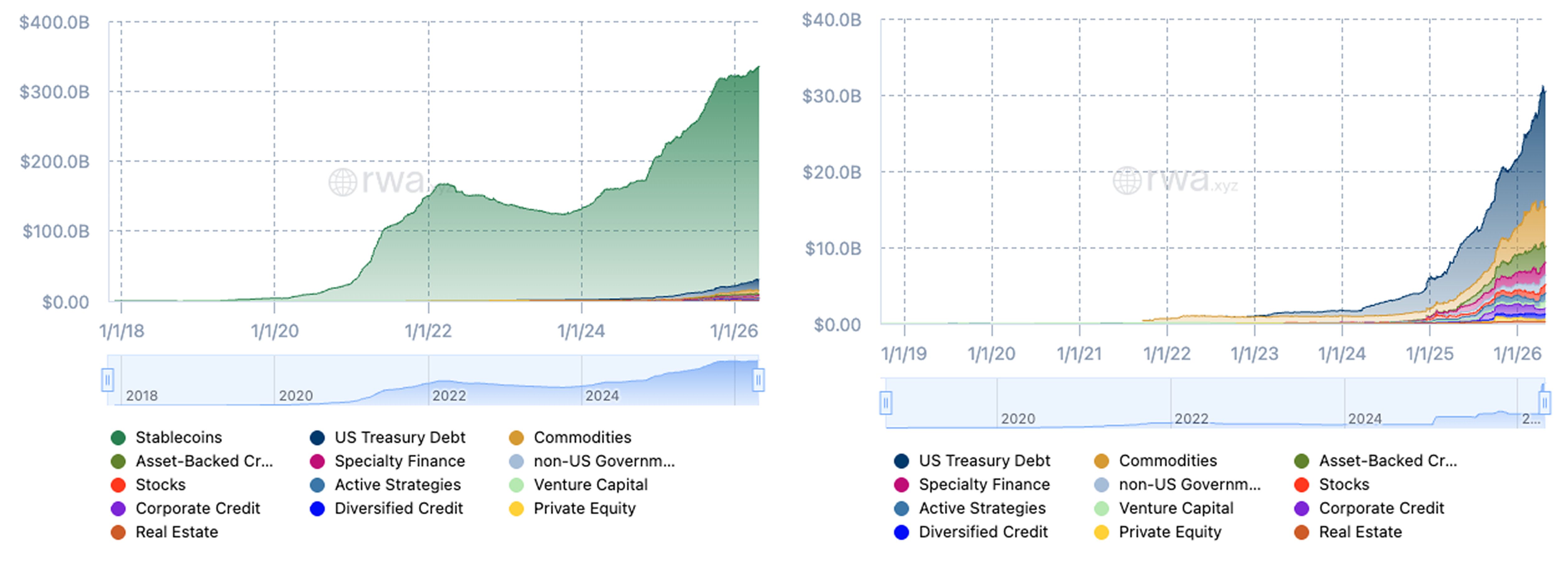
The charts below highlight the rapid growth of tokenised real-world assets (RWAs) moving onto the blockchain over time, showing a clear inflection point from 2024 onwards. The data shows a sharp acceleration led overwhelmingly by USD stablecoins and US Treasury Debt products, while other asset classes like commodities, and stocks are beginning to emerge.
For everyday Australians, understanding how blockchain works is no longer just interesting. It is increasingly relevant to how you invest, borrow, and build wealth.

Key Takeaways
-
Blockchain is a digital ledger that records transactions securely across a network of computers
-
Major institutions including JPMorgan, Morgan Stanley, and BlackRock are actively building on blockchain technology
-
Standard Chartered projects the tokenised asset market could grow to US$30 trillion by 2035
-
For Australians, blockchain finance is now accessible through products like crypto-backed loans and Bitcoin-backed home loans.
-
Block Earner supports over 350 cryptocurrencies and provides Australians with practical ways to put blockchain assets to work
What is Blockchain?
Blockchain is a distributed digital ledger that records transactions across a network of computers in a way that is transparent, secure, and tamper-resistant. No single party controls it. Instead, every participant in the network holds a copy, and any new entry must be verified by the network before it is added.
Think of it like a shared spreadsheet that thousands of computers around the world update simultaneously. Once a transaction is recorded, it cannot be altered without changing every subsequent record across every copy of the ledger. That makes fraud and manipulation extraordinarily difficult.
Originally conceived as the underlying technology for Bitcoin, blockchain has since evolved well beyond digital currency. It now powers smart contracts, decentralised finance (DeFi), tokenised real-world assets, and a new generation of financial infrastructure being built by some of the world's largest institutions.
How Does Blockchain Work?
Blockchain works by grouping transactions into "blocks", which are then linked together in a chronological "chain." Each block contains a batch of verified transactions, a timestamp, and a cryptographic reference to the block before it. This structure makes the record permanent and transparent.
When you send cryptocurrency to another person, the transaction is broadcast to the network. Nodes (computers running the blockchain software) validate the transaction against the existing ledger. Once enough nodes agree the transaction is legitimate, it is grouped into a block, added to the chain, and recorded permanently.
This process eliminates the need for a central authority like a bank or clearinghouse to verify or approve the transaction. The network does it collectively.
Blockchain Simply Explained:
Imagine sending money to a friend overseas. Traditionally, that involves your bank, their bank, a correspondent bank in between, multiple currencies, fees, and a wait of several days. With blockchain, the transaction is verified by the network, settled in minutes or seconds, and recorded permanently with no intermediary taking a cut.
The same principle applies to more complex financial instruments. A smart contract is a self-executing agreement written into the blockchain code. When certain conditions are met, it executes automatically. No lawyers, no administrators, no delays.
This is why blockchain is not just a faster payment system. It is a fundamentally different way of establishing and transferring trust.
How Blockchain is Impacting Everyday Aussies
Blockchain's impact on Australians is more tangible than most people realise. The technology is already embedded in financial products accessible right now.
Cryptocurrency ownership
Buying and owning crypto is the most obvious entry point. Millions of Australians hold Bitcoin, Ethereum, or other digital assets, all of which run on blockchain infrastructure. According to the Australian Taxation Office, crypto is now mainstream enough that it runs a dedicated data-matching program with exchanges to track holdings and transactions.
DeFi and Staking products
DeFi (Decentralised Finance) products allow Australians to use crypto assets by participating in protocols governed by smart contracts.
Crypto-Backed Loans
A crypto-backed loan lets you borrow AUD against your cryptocurrency holdings without selling them, meaning no disposal, no CGT event, and no lost market exposure.
They are one of the most practical applications of blockchain for Australian investors. Rather than selling your crypto assets and triggering a capital gains tax event, products like Block Earner's crypto-backed loans allow you to borrow AUD against your holdings. Your assets stay on the blockchain, secured as security, while you access the liquidity you need.
Taking it further, Block Earner's Bitcoin-backed home loans let Australian Bitcoin holders use their crypto equity to help finance a property purchase, one of the most significant intersections of blockchain technology and everyday Australian financial life.
Block Earner supports over 350 cryptocurrencies, giving Australians broad access to the blockchain ecosystem through a locally regulated platform. If you want to explore your options, you can contact the Block Earner team directly.
What Industry Leaders Are Saying About Blockchain
The most telling signal that blockchain has moved from speculative technology to critical infrastructure is who is now saying so publicly.
Jamie Dimon, CEO of JPMorgan Chase
Jamie Dimon has long been one of crypto's most prominent skeptics. That makes his recent shift in position particularly significant. Speaking at the Fortune Most Powerful Women Summit in October 2025, Dimon acknowledged that "blockchain is real" and predicted it would replace certain financial systems that are currently "clunky or late or not 24/7."
In his April 2026 annual shareholder letter, he went further, warning that JPMorgan faced growing competition from "a whole new set of competitors based on blockchain, which includes stablecoins, smart contracts and other forms of tokenisation," before adding: "We need to roll out our own blockchain technology."
JPMorgan is not starting from scratch. Its Kinexys blockchain unit has been quietly expanding for years, and the bank was involved in the first US commercial paper issuance on the Solana blockchain in 2025.
Morgan Stanley
Morgan Stanley Investment Management has made it’s own decisive move and launched the Morgan Stanley Bitcoin Trust, formally entering the digital asset investment space. Morgan Stanley's entry into spot Bitcoin ETFs is accelerating institutional adoption broadly, bringing significant new capital and credibility to the asset class.
Larry Fink, CEO of BlackRock
BlackRock is the world's largest asset manager and has been among the most vocal advocates for blockchain's transformative potential. BlackRock CEO Larry Fink stated the financial industry is at “the beginning of the tokenisation of all assets” during an Oct. 14 interview on CNBC’s Squawk on the Street.
He has described the tokenisation of financial assets as a shift that "would revolutionise financial ownership," enabling 24/7 markets, near-instant settlement, and dramatically reduced costs for investors worldwide. BlackRock now manages billions through its own tokenised products, BlackRock’s iShares Bitcoin Trust (IBIT) ETF, launched on Nov. 19, 2024, saw an unprecedented $1.9 billion in notional exposure on its first day of trading.
Standard Chartered
Standard Chartered has put numbers on the opportunity. The bank projects that tokenised real-world assets will grow from approximately US$350 billion today to US$30 trillion by 2035, driven by maturing infrastructure and growing institutional participation.
Geoffrey Kendrick, head of digital asset research at Standard Chartered, noted that stablecoins have laid the groundwork for this next wave of tokenisation, primarily built on the Ethereum network. The picture that emerges from these voices is consistent: blockchain technology is not a trend to monitor from a distance. It is infrastructure being actively built and adopted by the institutions that underpin global finance.
Explore Blockchain Finance With Block Earner
Blockchain is reshaping how value is exchanged globally, and Australians have more ways than ever to participate. Whether you are holding crypto as a long-term investment, looking to borrow against your assets without selling, or exploring how your Bitcoin equity can contribute to a home purchase, the products now exist to make that possible.
Block Earner is an Australian crypto finance platform recognised for its continued innovation and industry leadership, recently winning the 2026 WeMoney Best Crypto-Backed Lending Award. This latest recognition builds on a strong track record, including multiple wins at the 2025 Finder Innovation Awards, and earlier wins such as the 2024 WeMoney Lending Innovation of the Year and the Digital Economy Council of Australia’s Financial Services Innovator of the Year.
We support over 350 cryptocurrencies and offer crypto-backed loans, BTC-backed loans, and Bitcoin-backed home loans designed for the Australian market.
Ready to put your crypto to work? Get in touch with our team today.
Frequently Asked Questions: Blockchain Technology
Is blockchain the same as cryptocurrency?
No. Cryptocurrency is one application of blockchain technology, but blockchain itself is a broader infrastructure. It can be used to record any kind of transaction or data, from financial trades and property ownership to voting records and supply chain data. Crypto like Bitcoin was where blockchain started, but institutions are now using it to tokenise stocks, bonds, commodities and real estate.
How does blockchain technology work for cryptocurrency?
Cryptocurrency transactions are broadcast to the blockchain network, verified by nodes (computers running the blockchain software), and then permanently recorded in a new block. Bitcoin runs on its own blockchain, while Ethereum runs on another. Each network has its own rules for validation, but the core principle of decentralised verification is consistent across all major blockchains.
How can Australians use blockchain technology today?
Australians can access blockchain technology through cryptocurrency ownership, DeFi protocols, and products like crypto-backed loans and Bitcoin-backed home loans. These products allow you to put your digital assets to work without selling them, preserving your exposure while accessing AUD liquidity. Contact Block Earner to find out more.
Disclaimer: The information contained in this blog is general in nature and is provided for informational purposes only. It does not constitute financial, legal, or tax advice, and should not be relied upon as such. Block Earner does not guarantee the accuracy or completeness of any information presented. You should consider your own personal circumstances and seek professional advice before making any financial or investment decisions. Past performance is not indicative of future results. All investments carry risk.