Market Update
21 New Tokens Now Live on Block Earner: A Read on Where the Market Is Heading
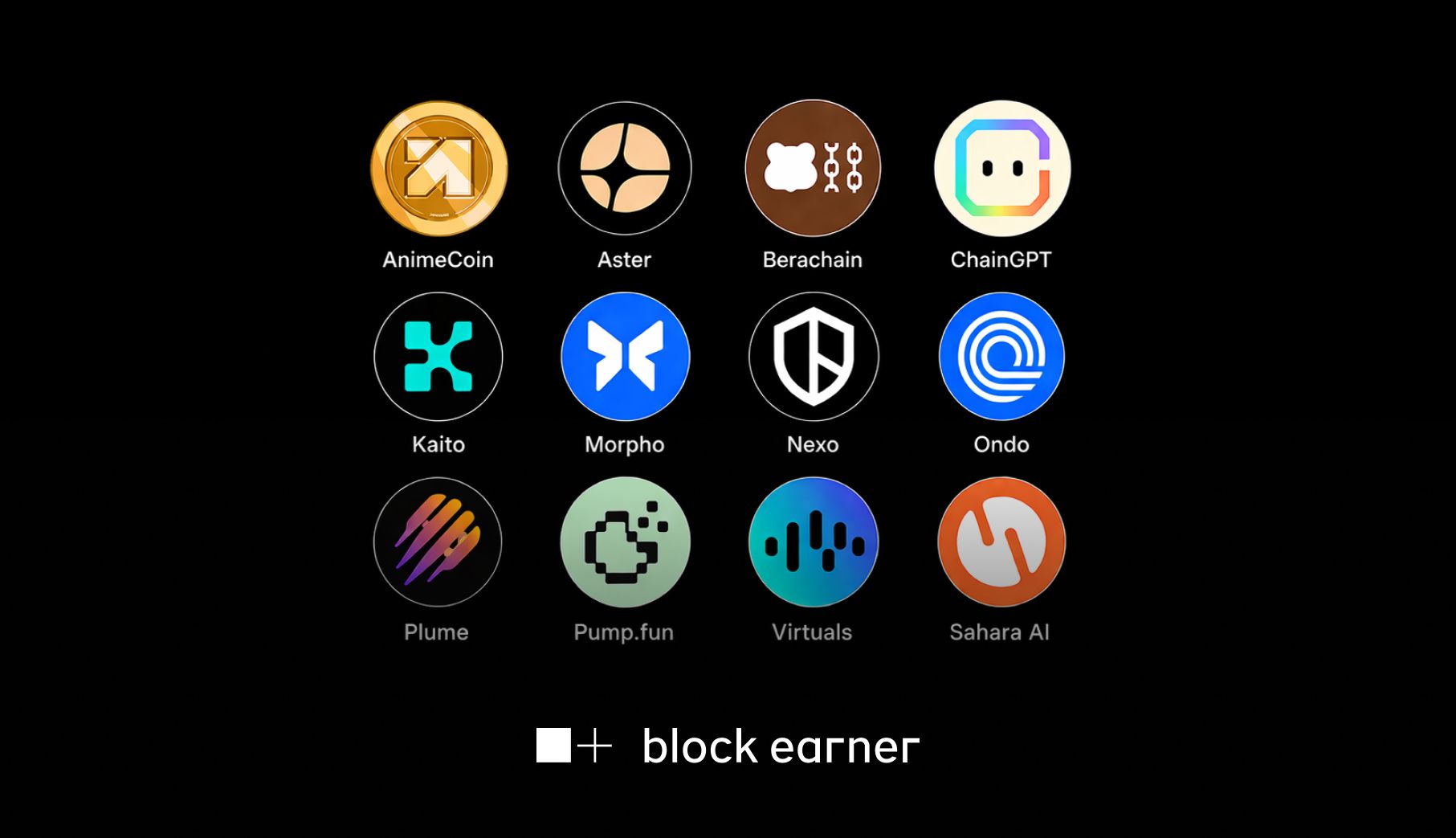


Every listing wave tells a story about where crypto is moving. This one is no exception. We've added 21 new tokens to Block Earner this round, all tradeable directly with AUD.
Below is a quick guide to each new listing, what the project actually does, and why it might matter to your portfolio.

AI and the agent economy
The AI x crypto thesis has graduated from speculation to category. These five tokens cover the major angles of the stack.
What Is Virtuals Protocol (VIRTUAL)?
Virtuals Protocol is a launchpad for creating, tokenising, and monetising AI agents for gaming, entertainment, and virtual environments without coding expertise. Launched on Base in October 2024, it pairs AI agent creation with built-in revenue sharing through tokenisation.
- No-code AI agent creation lets anyone deploy on-chain agents and tokenise them for shared ownership.
- Each agent is paired with a tradable token that distributes revenue to co-owners.
- Open agent marketplace gives projects native access to crypto infrastructure, supporting Virtuals' goal of an AI agent economy.
What Is Kaito (KAITO)?
Kaito is an AI-powered information and intelligence platform that organises crypto attention, data, and capital flows. Founded in 2022 by ex-Citadel manager Yu Hu, it tackles crypto's information fragmentation through Web3 search and analytics tools.
- Operates four main products: Kaito Pro, Kaito Studio, Capital Launchpad, and the upcoming Kaito Markets.
- Partners with Polymarket on Attention Markets, letting participants speculate on which projects capture mindshare.
- KAITO token shapes attention distribution in the InfoFi network, acts as the medium of exchange, and grants governance rights.
What Is ChainGPT (CGPT)?
ChainGPT is an AI infrastructure platform built for Web3, providing crypto-focused AI tools to users, developers, and enterprises. Its products are powered by large language and vision models trained on blockchain-native data.
- Suite of AI products including a smart contract generator, real-time auditor, AI trading assistant, AI NFT generator, and Telegram bot.
- CGPT.Fun no-code launchpad lets users create and deploy AI agents without writing code.
- CGPT token is the medium of exchange for premium features, with staking unlocking higher tier access.
What Is Sahara AI (SAHARA)?
Sahara AI is a decentralised, AI-native blockchain platform built to democratise AI by enabling community ownership and monetisation of data, models, and agents. Its mission is to return attribution and revenue rights from a few large AI companies back to the individual contributors who power them.
- Data Services Platform for crowdsourced data labelling and refinement, plus an AI Developer Platform for building and deploying models.
- Decentralised AI Marketplace where users can buy and sell datasets, models, agents, and compute.
- SAHARA token is the economic and governance backbone, with around 64% of the 10 billion supply earmarked for community and ecosystem incentives.
What Is Cookie DAO (COOKIE)?
Cookie DAO is a decentralised AI data aggregator and Web3 infrastructure project that tokenises social and on-chain insights to power AI agents and reward contributors. Its flagship product, cookie.fun, indexes AI agents and acts as a modular data layer for the agentic economy.
- COOKIE token gates premium data on cookie.fun and is required for AI agents that consume Cookie DAO APIs.
- Token holders earn revenue share from API fees paid by agents using the data layer.
- Holders also get governance voting rights over DAO proposals on data indexing and incentives.
DeFi grows up
The new DeFi listings reflect a sector that is no longer chasing yield for yield's sake. These six are protocols moving real volume, real revenue, and increasingly, real institutional capital.
What Is Morpho (MORPHO)?
Morpho is an open, modular, and permissionless base layer for on-chain credit, designed to bring efficiency and institutional-grade lending to DeFi. It connects lenders and borrowers directly to optimise interest rates and capital efficiency on Ethereum.
- Morpho Blue is a lightweight permissionless primitive for spinning up customisable, isolated lending markets with externalised risk.
- Morpho Vaults give passive lenders non-custodial, automatically optimised yield strategies.
- MORPHO token governs the protocol and underpins decisions across vaults, markets, and risk parameters.
What Is Maple Finance (SYRUP)?
Maple Finance is a DeFi platform specialising in institutional lending, with its Syrup product extending Maple's institutional-grade yields to retail DeFi users. The protocol enables overcollateralised, fixed-rate lending between accredited borrowers and on-chain lenders.
- Permissioned marketplace where institutional borrowers unlock liquidity and accredited investors earn yield on digital assets.
- Syrup.fi exposes Maple's institutional yields to broader DeFi, often outperforming protocols like Aave by several percentage points APY.
- SYRUP token governs the Maple/Syrup ecosystem and replaced MPL via a 1:100 migration in November 2024.
What Is Aster (ASTER)?
Aster is a multi-chain decentralised exchange offering both spot and perpetuals trading, formed from the 2025 merger of Astherus (a yield protocol) and APX Finance (a perp DEX). It runs across BNB Chain, Ethereum, Solana and Arbitrum today, with its own purpose-built Layer 1, Aster Chain, on the roadmap for 2026.
- "Trade & Earn" model lets users post yield-bearing assets like asBNB and USDF as margin so collateral keeps earning passive yield while being deployed in leveraged trades.
- Two trading modes: Simple Mode for one-click leveraged trades with MEV protection, and Pro Mode with advanced order types and analytics.
- Aster Chain L1 is designed for privacy-preserving perpetual trading using zero-knowledge proofs, with publicly stated targets of 100,000+ TPS and ~50ms block latency; mainnet is scheduled for 2026.
What Is Meteora (MET)?
Meteora is a Solana-based liquidity composability layer and DEX that powers liquidity pools through innovations like dynamic fees and configurable bin steps. It evolved from Mercurial Finance, which rebranded after the 2022 FTX collapse.
- Dynamic Liquidity Market Maker (DLMM) is a concentrated liquidity AMM that boosts LP profitability and helps new tokens bootstrap liquidity efficiently.
- Captures roughly a fifth of Solana DEX volume, ranking among the top three Solana DEXs alongside Raydium and Orca.
- MET has a 1 billion total supply with a community-heavy distribution, including a 20% allocation to former MER stakeholders.
What Is Enzyme (MLN)?
Founded in 2017, Enzyme is decentralised infrastructure for tokenised asset management on Ethereum, letting users create and operate non-custodial investment vaults. It emphasises transparency, modular strategies, and built-in risk controls so on-chain funds can run with less operational overhead than traditional setups.
- Vault architecture lets managers build, audit, and run repeatable on-chain investment strategies with auditable share ownership.
- Products include Enzyme Blue for self-serve vault creation and Onyx for institutional-grade cross-chain management.
- MLN token is used for protocol governance, fund management execution, and core utility within the network.
What Is Nexo (NEXO)?
Nexo is a digital-assets wealth platform that lets users earn yield on, borrow against, and manage their crypto holdings, supported by 24/7 client care. It combines lending, savings, trading, and card products in a single integrated service.
- Crypto-backed loans, flexible and fixed-term savings, exchange and trading tools, and a crypto debit/credit card.
- NEXO token holders can earn elevated interest rates on assets and unlock the Nexo Loyalty Program.
- Loyalty perks include borrowing rates from 2.9% APR, up to 2% card cashback, and discounted exchange fees.
Real-world assets and stablecoins
Tokenised treasuries, stable-asset infrastructure, and the rails that move real money on-chain are arguably the most consequential build of this cycle. These three are the plumbing of the next wave.
What Is Ondo (ONDO)?
Ondo is a decentralised finance platform bridging traditional finance with blockchain by tokenising institutional-grade real-world assets such as US Treasuries and equities. ONDO is its governance token, steering the Ondo DAO and connected products.
- USDY is a yield-bearing stablecoin offering compliant, on-chain access to US-dollar-denominated yield.
- OUSG provides tokenised exposure to short-term US Treasuries and has attracted significant institutional TVL.
- ONDO token governs the Ondo DAO, which oversees ecosystem components like the Flux Finance lending protocol.
What Is Plume (PLUME)?
Plume is a modular, EVM-compatible Layer 1 purpose-built for tokenising real-world assets and integrating them into DeFi. Rather than copying TradFi onto chain, it focuses on crypto-native RWA use cases like RWA derivatives, yield farming, lending, and speculation.
- RWAfi-focused infrastructure with built-in compliance, tokenisation tooling, smart wallets, and a native oracle.
- Has tokenised over $1B in assets across categories such as mineral rights and carbon credits.
- Drew 3.75M testnet users ahead of mainnet, signalling strong developer and consumer interest.
What Is USDS (USDS)?
USDS is the flagship stablecoin of the decentralised Sky ecosystem (the rebranded MakerDAO) and the upgraded successor to DAI. It maintains a soft peg to the US dollar through over-collateralisation, with users minting USDS by depositing assets like ETH or USDC into vaults.
- Decentralised governance via SKY token holders, who vote on collateral types, interest rates, and protocol changes.
- Holders can earn the variable Sky Savings Rate (SSR) or accrue SKY via Sky Token Rewards (STRs).
- Backed by transparent on-chain collateral with automated liquidations, contrasting with company-controlled stablecoins like USDC and USDT.
New chains and networks
The infrastructure layer keeps expanding. These four cover the new L1s, payment networks, and interoperability protocols joining the catalogue.
What Is Berachain (BERA)?
Berachain is an EVM-identical Layer 1 built with the Cosmos SDK that introduces a Proof-of-Liquidity consensus, where rewards are tied to liquidity provided rather than passive staking. The design separates the gas token from the governance token to keep the network liquidity-rich and applications well-incentivised.
- Three-token model: BERA (gas/staking), BGT (non-transferable governance earned via dApp activity), and HONEY (native USD-pegged stablecoin).
- Validators stake BERA and direct BGT rewards to application reward vaults, creating a marketplace between validators, users, and apps.
- Full EVM compatibility means existing Ethereum tooling and contracts deploy without modification.
What Is Plasma (XPL)?
Plasma is a Layer 1 blockchain purpose-built for global stablecoin payments, offering zero-fee USDT transfers and full EVM compatibility. Rather than a general-purpose chain, it positions itself as a dedicated "money chain" for instant, frictionless stablecoin settlement.
- Protocol-level paymaster sponsors gas for USDT transfers, so users can move stablecoins without holding XPL or paying fees.
- PlasmaBFT consensus and a Reth-based execution layer target thousands of TPS with rapid finality and full Ethereum smart contract compatibility.
- Native Bitcoin bridge enables trust-minimised BTC use inside smart contracts; XPL is the staking, governance, and validator-reward token.
What Is ARK (ARK)?
ARK is a blockchain development platform launched in 2016 that lets anyone deploy their own customisable, interoperable blockchain. It reduces reliance on traditional smart contracts by using custom transaction logic and supporting multiple programming languages.
- Toolkit for building tailor-made blockchains without needing to learn new smart contract languages.
- Designed for cross-chain interoperability so independent ARK-based chains can communicate.
- Native ARK token used to secure the network, pay fees, and incentivise delegates under its DPoS consensus.
What Is Nomina (NOM)?
Nomina is a DeFi ecosystem combining an Ethereum-native interoperability protocol with a professional trading terminal built for delta-neutral strategies. It targets the fragmentation of multi-rollup DeFi by enabling sub-second cross-rollup verification and asset transfers.
- Interoperability protocol delivers fast communication and asset transfers between Ethereum rollups, with Ethereum-native security.
- Trading terminal centralises advanced tooling for funding-rate arbitrage and other delta-neutral plays across multiple DEXs.
- NOM token (a 1:75 redenomination of the former OMNI) covers governance, multi-rollup gas, and protocol security; backers include Pantera Capital and Coinbase Ventures.
The culture layer
Every cycle needs one. These three sit at the intersection of gaming, community, and the on-chain culture economy.
What Is Big Time (BIGTIME)?
Big Time is a free-to-play, multiplayer action RPG combining fast-paced combat with an open in-game economy and time-and-space exploration. Web3 elements are kept invisible to players so the experience appeals to mainstream gamers.
- BIGTIME token is fair-launched, earned only through gameplay drops while wielding an Hourglass, with no team or investor allocation.
- Two NFT classes: Cosmetic NFTs that customise weapons and characters, and SPACE NFTs that expand the personal Time Machine hub used to craft and upgrade items.
- Players collect rare loot, cosmetics, and tokens during combat, then trade or use them to decorate their avatar and personal metaverse.
What Is AnimeCoin (ANIME)?
Animecoin is a culture coin and utility token built to transform global anime fandom into a community-owned creative economy, anchored by its native Animechain Layer 3 blockchain and the Azuki NFT community. The project aims to turn passive viewers into active participants who can shape, own, and benefit from anime culture.
- Three-layer ecosystem combining Animechain (an Arbitrum Orbit L3), the Anime.com content/community hub, and AnimeDAO governance.
- ANIME serves as the gas token on Animechain and powers transactions, staking rewards, and DAO voting on proposals.
- 10 billion total supply with over 50% allocated to the community, Azuki holders, and ecosystem growth incentives.
What Is Pump Fun (PUMP)?
Pump.fun is a Solana-based memecoin launchpad that lets anyone create a token in minutes by uploading an image, name, and ticker for less than $2 in fees. Launched in January 2024, it has become one of Solana's largest sources of activity, with millions of tokens minted on the platform.
- Every new token launches on a bonding curve that auto-prices supply; once it reaches roughly a $69k market cap it graduates to PumpSwap, Pump.fun's own DEX launched in March 2025.
- Has generated more than 11.9 million tokens and hundreds of millions in cumulative revenue, making it a dominant force in memecoin issuance.
- PUMP token launched in July 2025 with a 1 trillion fixed total supply; the public ICO raised approximately $600M (with combined public and private sale figures often cited around $1.3B), and PUMP serves as the platform's utility and governance asset.
How to trade them
Head to the Buy/Sell tab in the Block Earner web app or mobile app, search for the token you want, and buy it directly with AUD.
Disclaimer: The information contained in this blog is general in nature and is provided for informational purposes only. It does not constitute financial, legal, or tax advice, and should not be relied upon as such. Block Earner does not guarantee the accuracy or completeness of any information presented. You should consider your own personal circumstances and seek professional advice before making any financial or investment decisions. Past performance is not indicative of future results. All investments carry risk.