

If you are considering a crypto-backed loan, understanding LVR is not optional; it is the single most important number governing your loan. It determines how much you can borrow, and whether your crypto security is healthy or unhealthy. This guide explains exactly how LVR works, what happens when crypto markets move, and how to keep your loan in a healthy position.
Key Takeaways
- LVR (Loan-to-Value Ratio) is the percentage of your loan amount relative to the value of your crypto security
- As crypto prices fall, your LVR rises, increasing the risk of a Default Notice
- Crypto liquidations on many platforms can happen automatically 24/7. Block Earner's 30-day Default Notice window protects against this
- Block Earner notifies borrowers at every LVR tier via email, in-app notification, and SMS
- The three main ways to manage your LVR are topping up your crypto security, repaying part of the loan in AUD, or selling a portion of your crypto security to make a repayment

What Is a Loan-to-Value Ratio (LVR)?
LVR stands for Loan-to-Value Ratio. It is the percentage relationship between the amount you have borrowed and the current market value of the crypto you have put up as security.
LVR is used by crypto lenders to measure loan health. A low LVR means your security comfortably covers your loan. A high LVR means you are close to the limit and your loan is at risk.
What Happens If the Price of My Crypto Security Goes Down?
If the price of your crypto goes down, your LVR will go up.
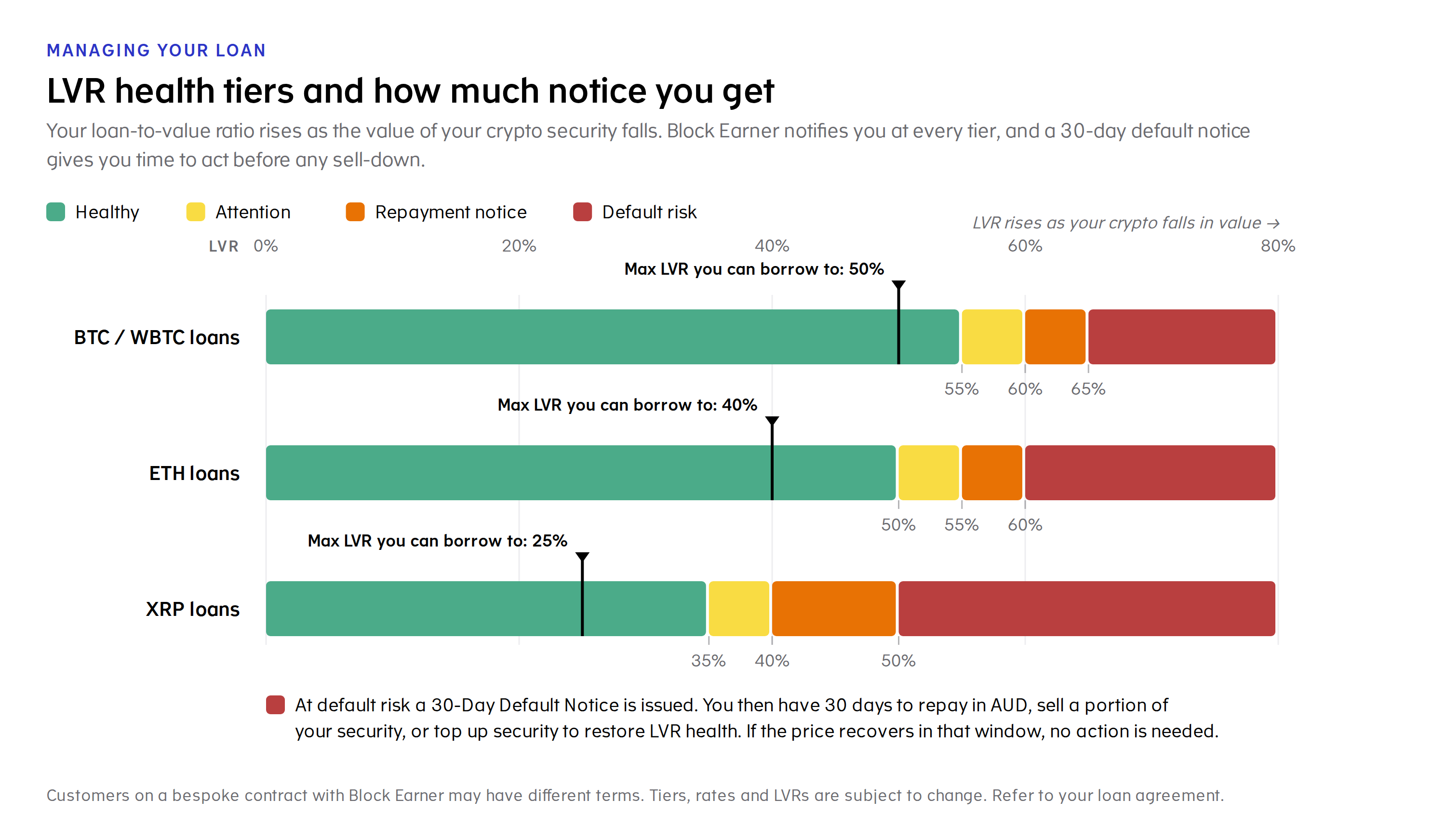
If your LVR reaches an unhealthy level, Block Earner will issue a 30-Day Default Notice. You then have 30 days to either:
- Repay a portion of your loan in AUD,
- Sell a portion of your crypto security to make a repayment, or
- Deposit additional crypto as security to restore LVR health.
If, during the 30-day notice period, the value of your crypto security increases and your LVR falls below the applicable Default Notice threshold, no further action is required.
If no action is taken and your LVR remains at or above the Default Notice threshold after the 30-day notice period, Block Earner may sell a portion of your crypto security to reduce your LVR in accordance with your loan terms.
LVR Health Stages (Last updated Aug 11, 2026)
The LVR health stages depend on the crypto security you have provided. Please see the different stages below.
Line of Credit
Crypto Security: BTC & wBTC
LVR Range:
Below 55%: Healthy
55–59.9%: Attention
60–64.9%: Repayment Notice
65% and above: Default Notice (30 days to manage)
Crypto Security: ETH
LVR Range:
Below 50%: Healthy
50–54.9%: Attention
55–59.9%: Repayment Notice
60% and above: Default Notice (30 days to manage)
XRP Security: XRP
Below 25–34.9%: Healthy
35–39.9%: Attention
40–49.9%: Repayment Notice
50% and above: Default Notice (30 days to manage)
Fixed Term
LVR Range: BTC, wBTC & ETH
Below 50%: Healthy
50–54.9%: Attention
55–59.9%: Repayment Notice
60% and above: Default Notice (30 days to manage)
To chat through these different stages, please book a call here.
Please note: For customers on a bespoke contract with Block Earner, the above may not apply.
Crypto Loans and Market Fluctuations
Crypto markets are volatile. A 20–30% price swing in a matter of days is not unusual, which means LVR can move quickly. Block Earner manages this by tracking your LVR in real time and alerting you at every tier so you always know where you stand.
When LVR Drops
A falling LVR is a good thing. If the value of your crypto security increases, for example, Bitcoin rises after you take out your loan — your LVR decreases, and your loan becomes healthier. You retain more buffer between your current position and any warning thresholds.
When LVR Falls Too Low
If your LVR falls significantly, you may have the option to draw down additional funds against your increased security value. Block Earner's redraw feature allows you to access additional AUD, giving you flexibility if your crypto security grows in value.
When LVR Rises
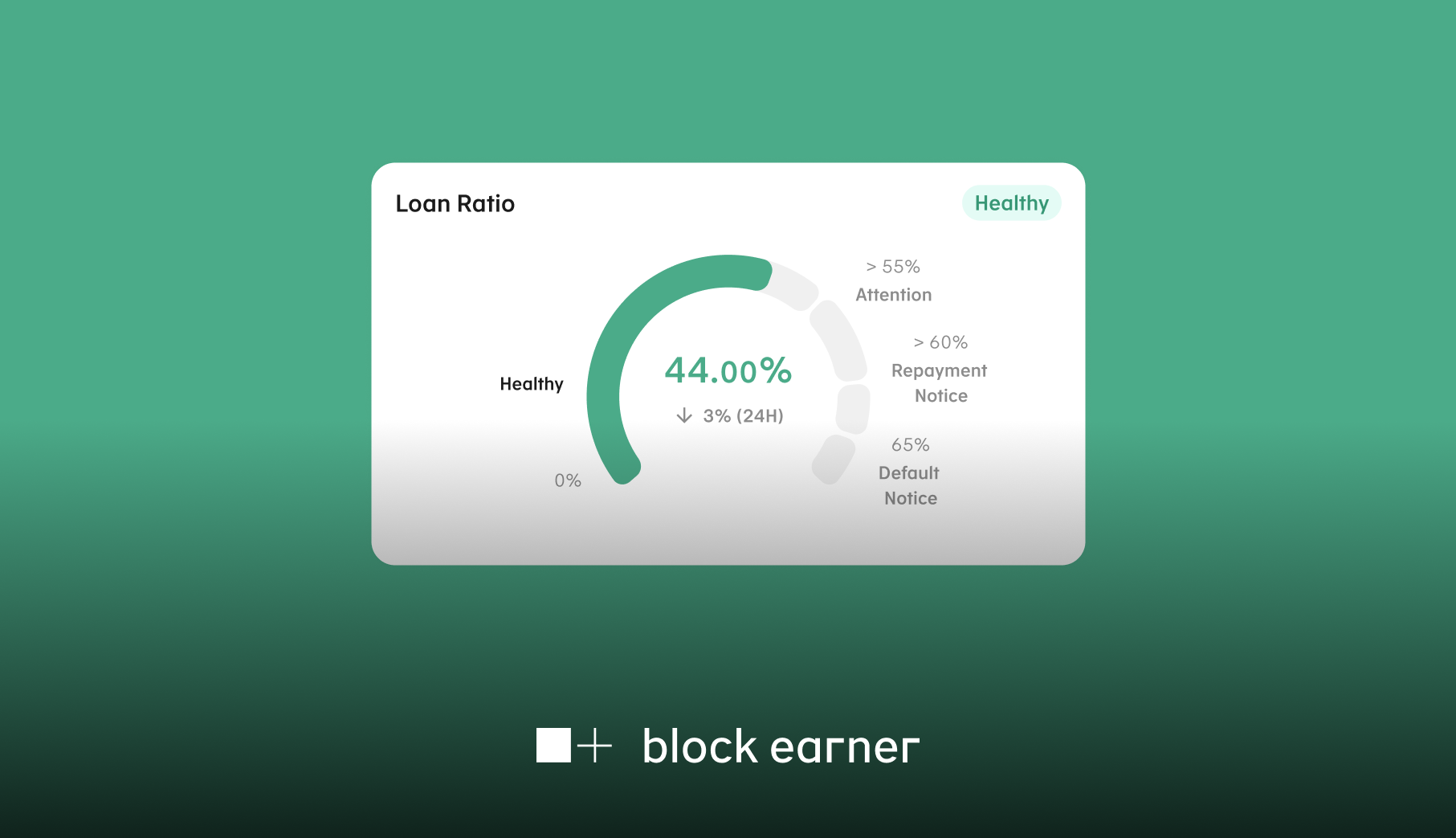
A rising LVR means your crypto security has decreased in value relative to your loan. Block Earner tracks this in real time via the app and sends notifications at every LVR tier by email, in-app alert, and SMS. You are never left in the dark about where your loan stands.
If your LVR reaches a warning threshold, you have a 30-day window to act before any further steps are taken.
Margin Calls and Default Notices
When LVR climbs too high, lenders issue what is known as a margin call or default notice. This is a formal notice that your loan health has deteriorated and action is required. What happens next, and how much time you have, varies significantly between platforms.
What Is a Healthy LVR?
A healthy LVR sits comfortably below your lender's warning threshold. For Block Earner's BTC, ETH, and WBTC loans, a healthy LVR sits between 40% and 50%; for XRP, it sits between 25% and 34.9%. The further below the threshold you are, the more buffer you have against market movements. Starting your loan at a lower LVR (borrowing less relative to your security) gives you more room to absorb volatility without triggering a warning.
Repayment Notices
Block Earner notifies borrowers at every LVR tier via email and in-app notification. When your LVR moves into a higher-risk zone, you receive a clear alert, and once it reaches the Default Notice threshold you have a 30-day window to take action. It's a meaningful protection that many offshore platforms do not offer, where competitors have no equivalent buffer and auto-rebalance at a set LVR threshold with no warning period.
During the 30-day window, you have three options to restore your loan to a healthy level: top up your crypto security, repay a portion of the loan in AUD, or sell a portion of your crypto security to make a repayment.
Default and Liquidation
If no action is taken within the notice window and your LVR remains at or above the Default Notice threshold, Block Earner may sell a portion of your crypto security to restore the loan to a healthy LVR, in accordance with your loan terms. This is a last resort, not a first response. The 30-day Default Notice window exists specifically to give borrowers time to act before liquidation becomes necessary.
To avoid reaching this point entirely, monitoring your LVR regularly via the Block Earner app is the single most effective habit a borrower can build.
How to Manage Your LVR
There are three primary ways to bring your LVR back down when it rises.
Option 1: Top Up Your Crypto Security
Depositing additional crypto into your loan increases the value of your security without changing your loan balance, which directly reduces your LVR.
Block Earner supports quick top-up via the app, so you can act quickly when the market moves.
Option 2: Repay Part of the Loan in AUD
Reducing your outstanding loan balance achieves the same result as adding security.
Partial repayments can be made at any time through the Block Earner app, giving you flexibility to manage your position without closing the loan entirely.
Option 3: Sell a Portion of Your Crypto Security
You can also sell a portion of your crypto security and use the proceeds to make a repayment, reducing your loan balance and bringing your LVR back into a healthy range. Please note: Selling crypto to make a repayment will include a Sell Crypto Fee of 0.6% incl. GST.
Block Earner: Australia's Home of Crypto Backed Loans
Block Earner is the first AUSTRAC registered crypto company in Australia to hold an Australian Credit Licence (ACL) issued by ASIC. That means every borrower is protected by Australian consumer lending law, not just platform terms and conditions.
Our real-time LVR tracking, tiered notification system, and 30-day Default Notice window are built to give Australian borrowers the tools and time to manage their loans confidently, even in volatile markets.
Whether you are borrowing against Bitcoin, Ethereum, or other supported assets, Block Earner's crypto-backed loans are designed around transparency, protection, and flexibility. Explore all supported cryptocurrencies or get in touch with our team to find out how much you could borrow.
Frequently Asked Questions
What is a good LVR for a crypto loan?
For Block Earner's BTC, ETH, and WBTC loans, a healthy LVR sits between 40% and 50%; for XRP, it sits between 25% and 34.9%. The lower your LVR, the more buffer you have against market movements. Starting your loan in the healthy range gives you meaningful room to absorb volatility before approaching any warning thresholds.
Can my crypto be sold without warning?
With Block Earner, no. You receive tiered notifications at every LVR threshold and, once you reach the Default Notice threshold, a 30-day window to act before any crypto security is sold. Many offshore platforms do not offer this protection and will liquidate automatically once a threshold is breached, including overnight or on weekends.
How often should I check my LVR?
During periods of high market volatility, checking daily is sensible. Block Earner's app displays your LVR in real time, and you will receive automatic notifications at every tier, so you do not need to monitor it manually around the clock. That said, staying aware of broader market conditions and your current LVR position is good practice for any crypto borrower.
Disclaimer: The information contained in this blog is general in nature and is provided for informational purposes only. It does not constitute financial, legal, or tax advice, and should not be relied upon as such. Block Earner does not guarantee the accuracy or completeness of any information presented. You should consider your own personal circumstances and seek professional advice before making any financial or investment decisions. Past performance is not indicative of future results. All investments carry risk. Crypto-backed loans carry real risks. The value of your crypto can fall sharply, rapidly increasing your LVR and reducing any initial buffer. This may require you to add security or repay part of the loan and could result in some or all of your crypto being sold.
Approved applicants only. Terms, conditions, fees and charges apply. Credit provided by Web3 Loans Pty Ltd ACN 668 516 952 and managed by Web3 Ventures Pty Ltd trading as Block Earner (ACN 655 090 869) under Australian Credit License 542689. Winner of 2024 Finnies Excellence in Blockchain/Distributed Ledger, 2024 Blockies Financial Services Innovator of the Year, and 2025 Finnies Excellence in Web3 (Blockchain or Crypto). Winner of the 2024 WeMoney Lending Innovation of the Year award for our Crypto-backed Loans. NB: These awards are for Block Earner's full suite of products and not specifically the Crypto-Backed Loans product.