
Market Update
318 Days Since Bitcoin's All-Time High: The CLARITY Act, the Halving Cycle, and Is the Bottom In on Bitcoin?



Key Takeaways
- Bitcoin is 318 days past its all-time high of US$126,080, set on 6 October 2025, and trades about 45% below it.
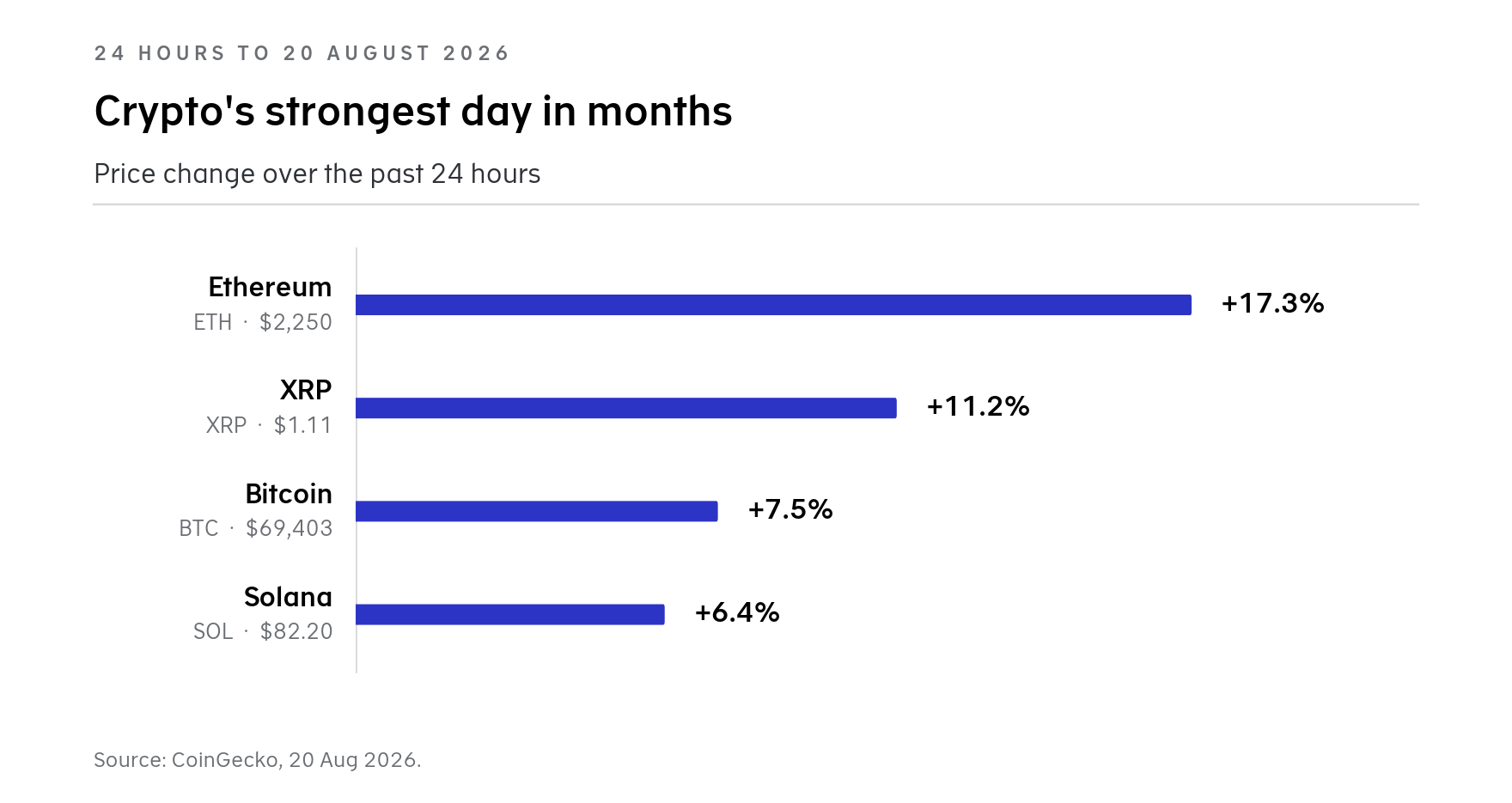
- Crypto just had its strongest day in months. Ethereum rose 17.3%, XRP 11.2%, Bitcoin 7.5% and Solana 6.4% over 24 hours, lifting total crypto market value 7.2% to US$2.45 trillion.
- The trigger was policy, not hype. The US Treasury expanded its buybacks of longer-dated bonds and the SEC proposed a new framework for crypto offerings, two signals landing on the same day.
- The CLARITY Act is the bill to watch. It would split US crypto oversight between the SEC and the CFTC. It passed the House in July 2025, cleared Senate Banking in May 2026, and awaits a full Senate vote expected in September.
- This is the mildest bear market on record. Bitcoin's low so far is 53.6% below the peak. The past three cycles took 77% to 85% off the top.
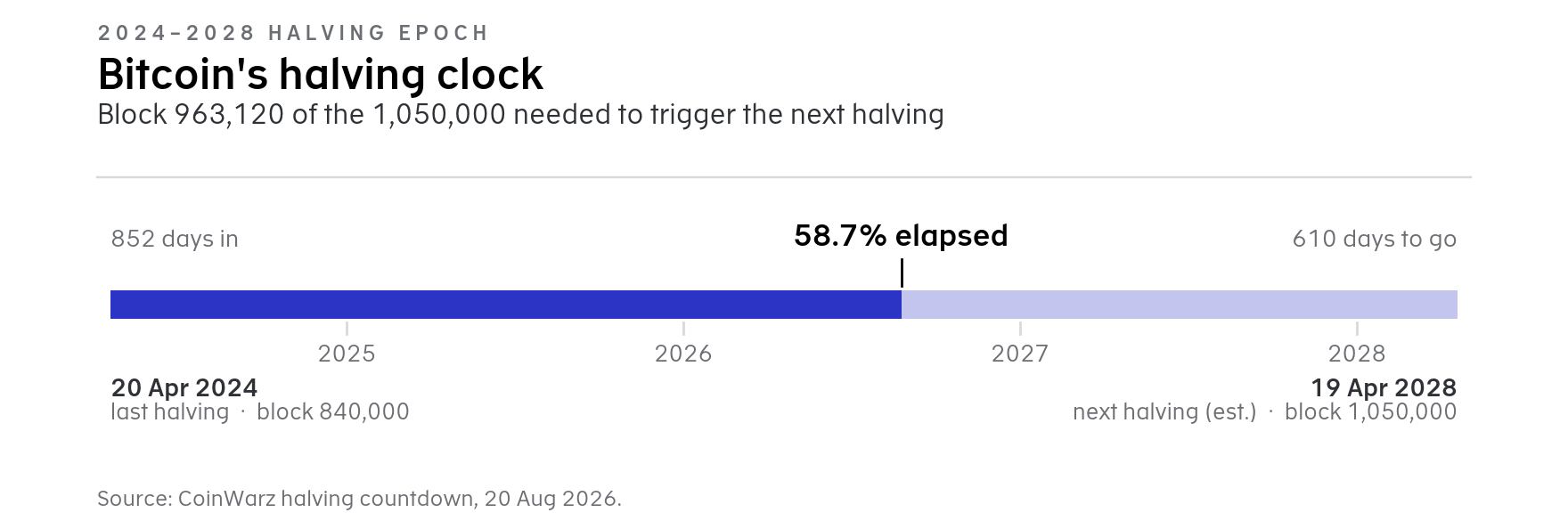
- We're 58.7% through the current halving cycle. The next halving is projected for 19 April 2028, around 610 days away.
- Altcoins have fallen further. Solana is 72% below its record and XRP 70%, against 45% for Bitcoin.

What just happened
If you have not been watching crypto closely, the last 24 hours are a good place to start again. Bitcoin climbed 7.5% to around US$69,403, its first time above US$69,000 in two months.
Ethereum did better still, rising 17.3% to US$2,250 and reclaiming the US$2,000 level it lost back in May. XRP added 11.2% to US$1.11 and Solana 6.4% to US$82.20. Total crypto market value rose 7.2% to roughly US$2.45 trillion, with Bitcoin accounting for 56.9% of it.
Around US$1.92 billion of leveraged positions were liquidated over the day, most of it in a four-hour window, a sign the rally caught a lot of traders betting the other way.
Two things set it off. The US Treasury said it would double the size of certain buybacks of longer-dated government bonds, which loosens financial conditions and tends to lift risk assets generally. And the SEC proposed a new framework for how crypto tokens can be offered to the public. Neither is a crypto-specific stimulus; both make the asset class look slightly less like a legal grey area.
The CLARITY Act, in plain English
The bill hanging over the US market for more than a year now is the Digital Asset Market Clarity Act, the CLARITY Act, or H.R.3633. It tries to answer a question the US has never properly settled: who regulates crypto? Right now the SEC and the CFTC both have partial claims, and which agency applies to which token has largely been decided case by case in court.
The bill draws a line. Assets that behave like commodities, Bitcoin being the obvious example, would sit with the CFTC. Tokens still tied to a company delivering on a roadmap become "ancillary assets" under the SEC, with disclosure obligations attached. It also sets custody rules for exchanges and gives digital commodity contracts safe-harbour treatment in bankruptcy, a direct response to the FTX collapse.
Where it stands as at 20 August 2026:
17 July 2025: passed the House 294–134, with bipartisan support.
14 May 2026: advanced out of the Senate Banking Committee on a 15–9 vote.
8 August 2026: the Senate Majority Leader filed a motion to proceed, starting the clock for a floor vote.
Now: the August window was missed. A vote is expected when the Senate returns in September, roughly a three-week session before the November midterms.
It needs 60 votes, which means at least ten Democrats have to come across. Three issues are holding it up: ethics rules restricting senior officials from backing crypto projects, how stablecoin rewards are treated, and law-enforcement provisions.
For Australian readers, none of this changes local rules. It matters because US regulatory clarity is what large institutional allocators have been waiting on, and because the market clearly prices it as a positive.
318 days since Bitcoin's all-time high
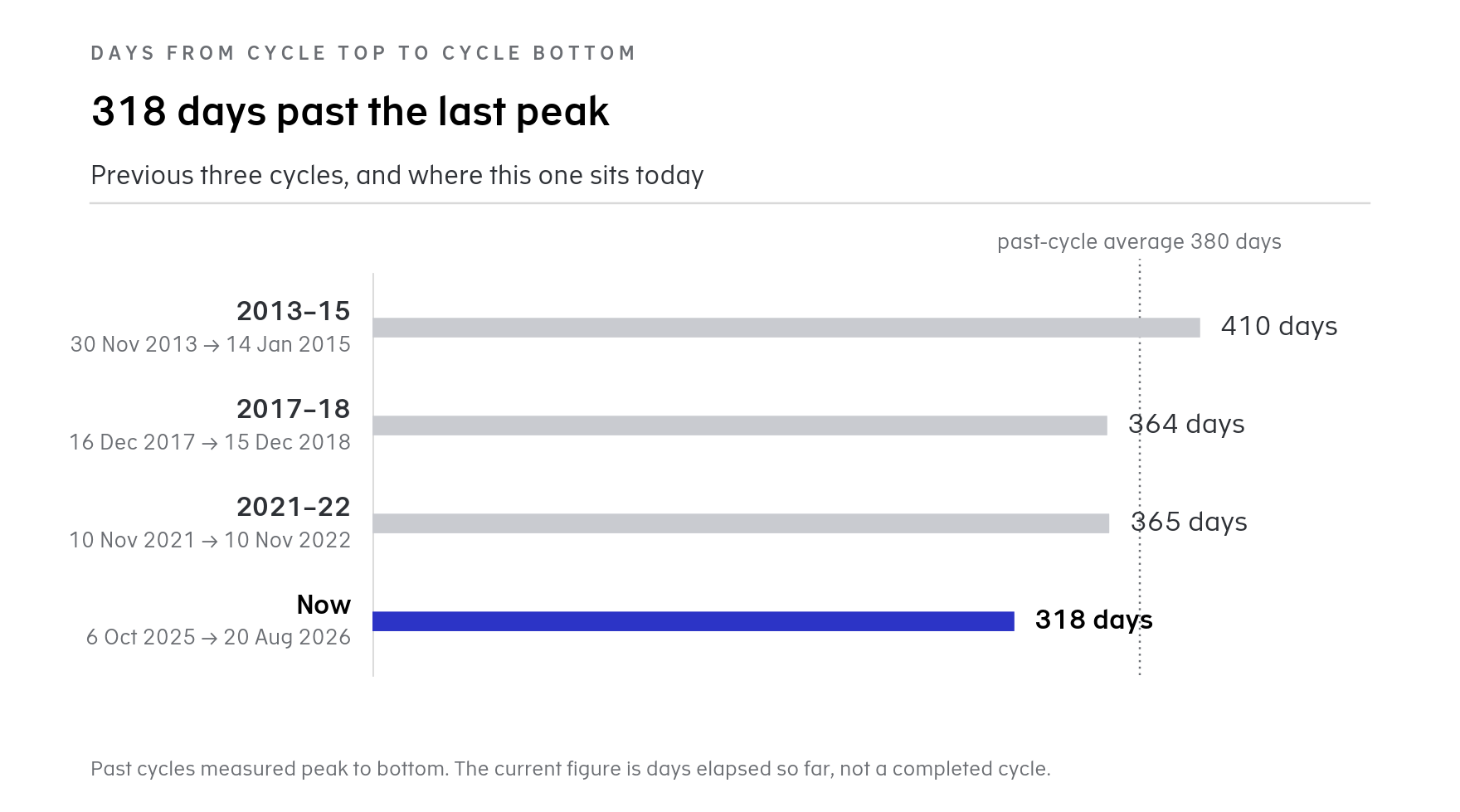
Bitcoin's record high was US$126,080, set on 6 October 2025. That was 318 days ago.
Since then it fell as low as roughly US$58,500 in early July 2026, 53.6% below the peak, before recovering to today's US$69,403, some 44.9% below the top. In other words, the recovery from the low is real but modest: Bitcoin is still worth less than half what it was at the height of the last cycle.
How this bear market compares to the last three
Bitcoin has now been through four of these. Setting them side by side is the most useful context a newcomer can have, because it separates what is unusual about this drawdown from what is simply normal.
Start with how long they lasted. Measured from cycle top to cycle bottom, the past three ran 410 days, 364 days and 365 days, an average of 380. This one is 318 days old and its lowest print so far came at day 268.
Now how deep they went. This is where the current cycle genuinely breaks the pattern.
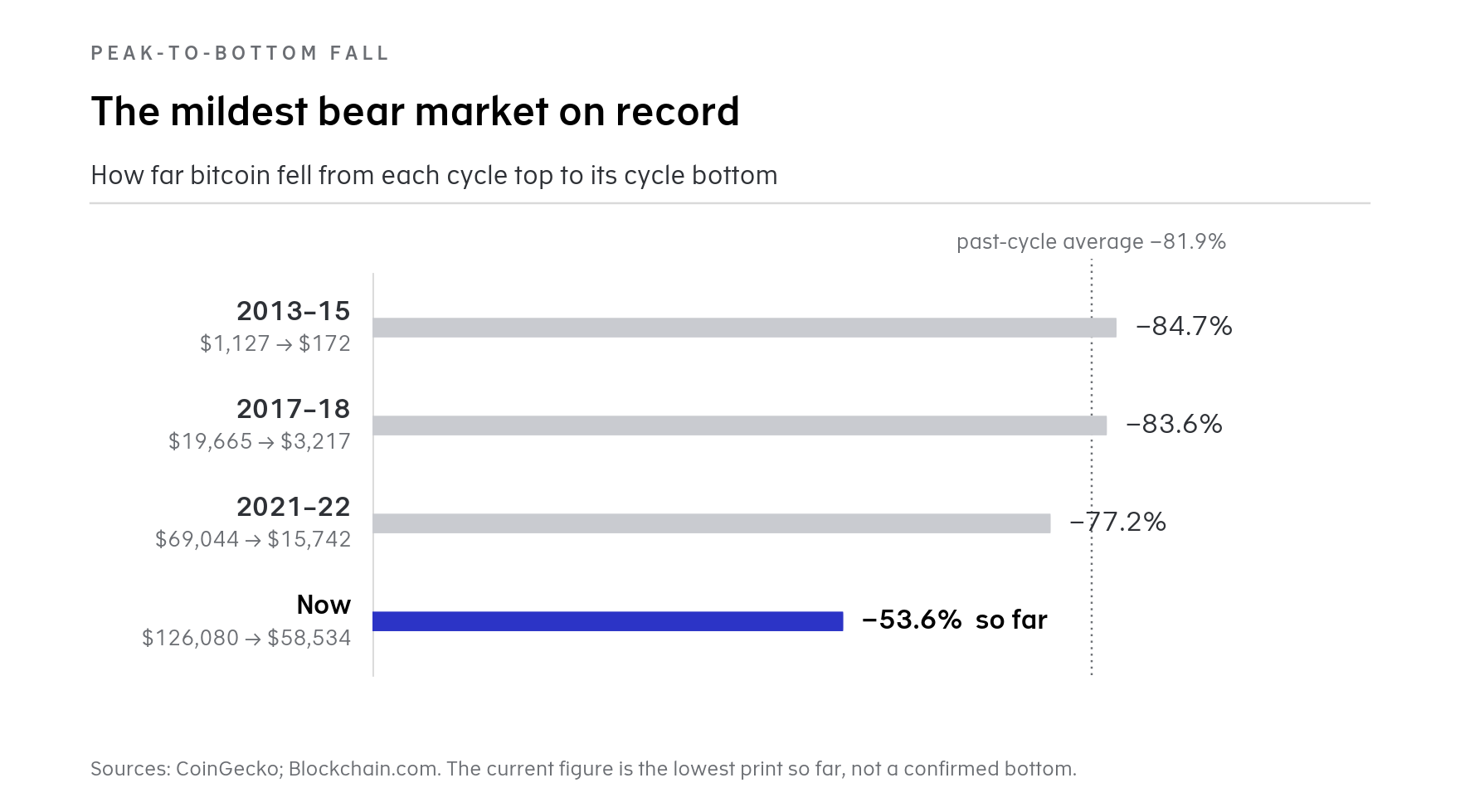
Every previous bear market took at least three quarters of Bitcoin's value off the top. This one has taken a little over half. That makes it the mildest on record, and it happened despite corporate selling, ETF outflows, miner liquidations and a rotation of speculative money into AI.
Honest caveat. Three completed cycles is not a statistical sample, so "about a year, then it turns" is a rhythm rather than a rule. And the current row is not finished: until a new all-time high is set, today's price is today’s price, not a confirmed bottom.
58.7% of the way through the halving cycle
Roughly every four years, the reward paid to Bitcoin miners for producing a block is cut in half. It happened most recently on 20 April 2024, when the reward dropped from 6.25 BTC to 3.125 BTC. Because issuance is the one variable Bitcoin's code fixes in advance, a lot of market commentary is organised around this four-year clock.
As at 20 August 2026 we are 852 days past the last halving, which puts us 58.7% of the way through the current epoch. At current block times the next halving lands around 19 April 2028, roughly 610 days from now, and the reward drops to 1.5625 BTC.
Plotted against price on a log scale, that position is easier to see. Shade the first 58.7% of every halving epoch and the band edges all mark the same point in their respective cycles.
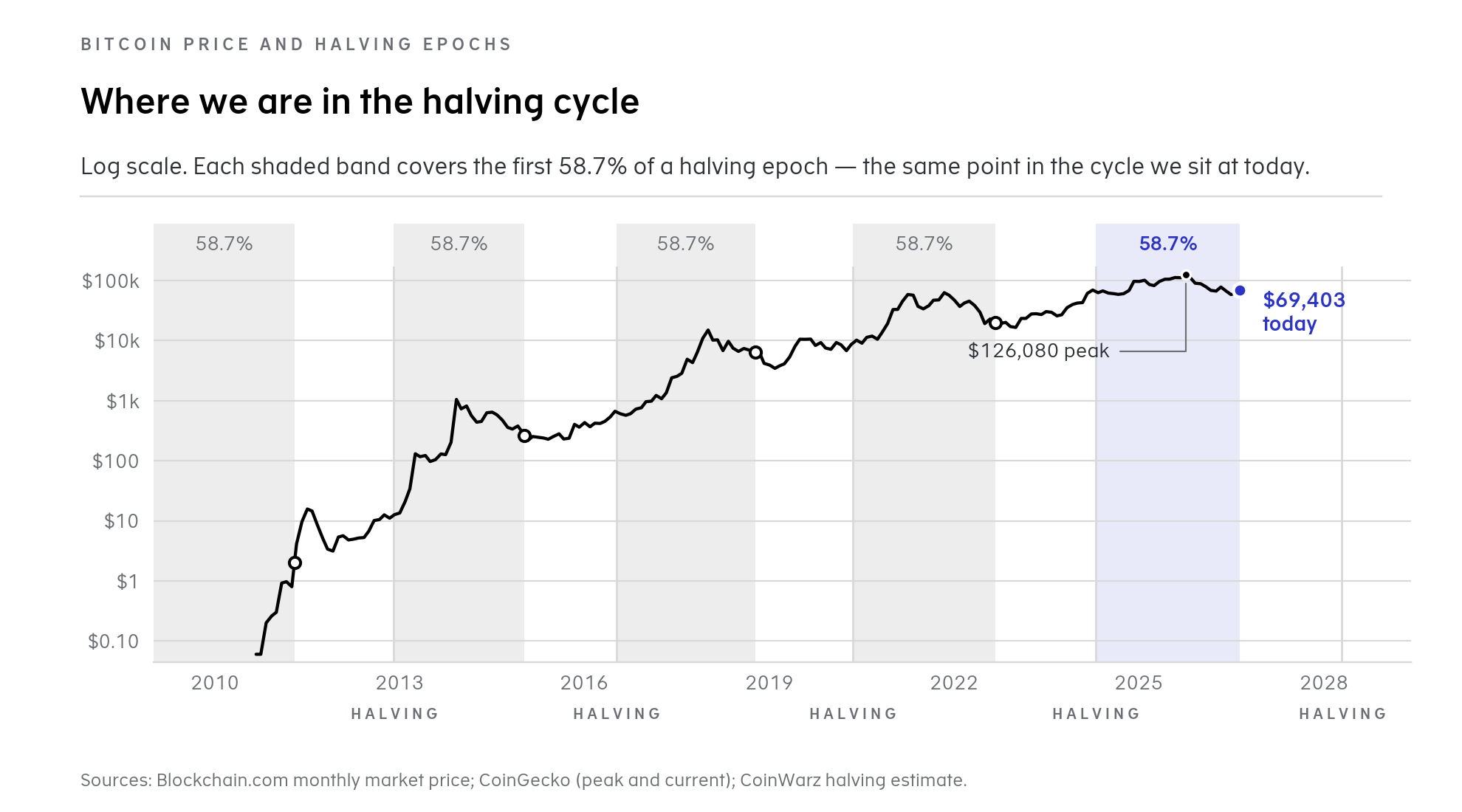
Worth stating plainly: the halving is a supply event with a known date, not a forecast, and each one matters less arithmetically than the last, because the amount of new Bitcoin removed from issuance shrinks every time.
How far the majors have fallen
Drawdowns have not been evenly spread. The further out the risk curve you go, the deeper the hole.
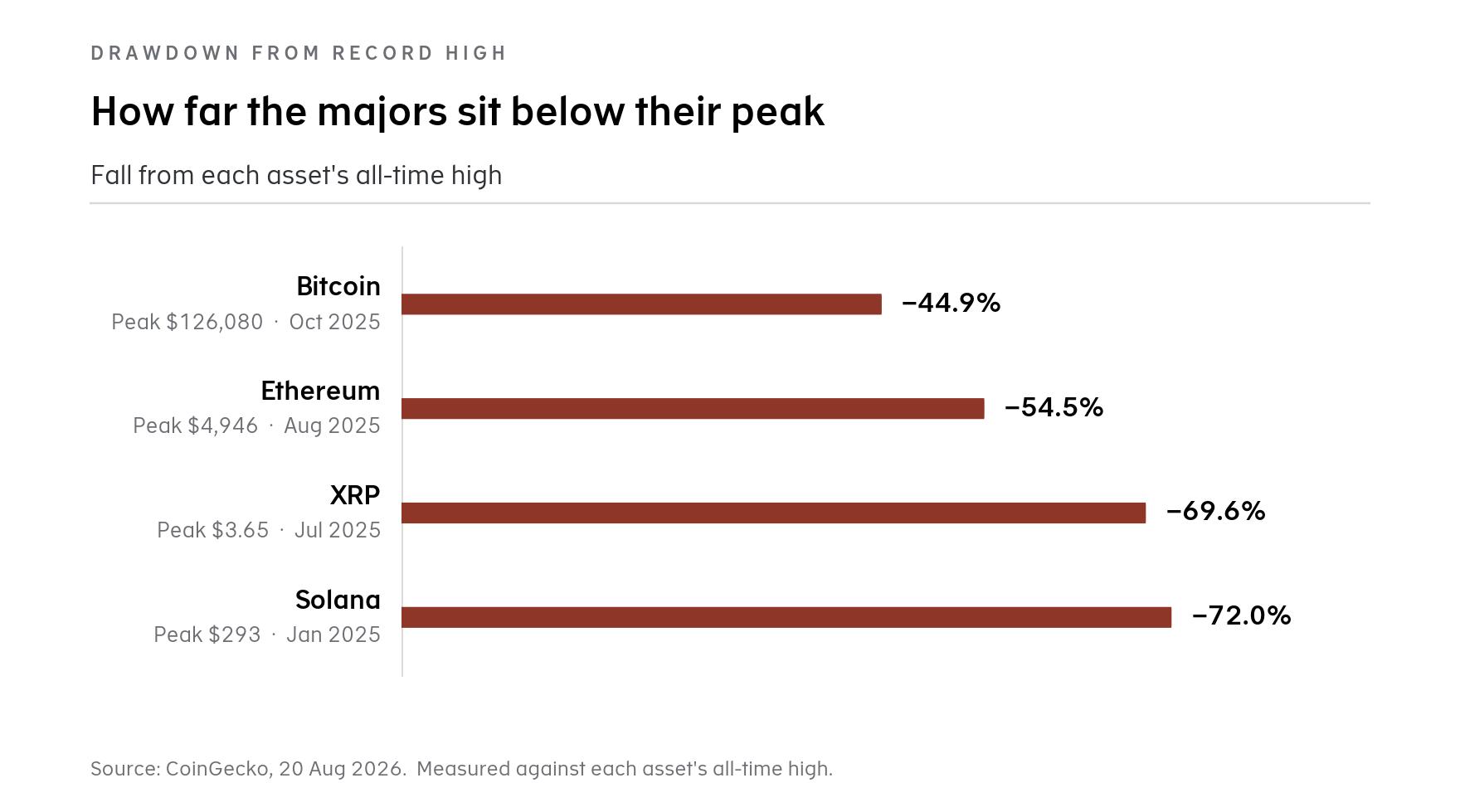
Bitcoin has held up best at 44.9% below its October 2025 record. Ethereum is 54.5% below its August 2025 high of US$4,946. XRP sits 69.6% below the US$3.65 it reached in July 2025, and Solana 72.0% below the US$293 it hit in January 2025. Bitcoin's share of total crypto market value is now 56.9%, the same story told a different way. Capital has concentrated in the largest asset.
What it adds up to
Three separate clocks are running. Bitcoin is 318 days into a drawdown that in past cycles ran around a year, and this one is far shallower than any before it. We are 58.7% through a halving epoch, with the next supply cut just over 600 days out. And a US bill that would settle who regulates what has a narrow window in September before election-year politics closes it.
A single 7.5% day rally is a nice pump. What it shows is how much of crypto's price action now runs on policy and macro plumbing rather than sentiment, which, for anyone approaching this market from the outside, is a more legible place to start than it used to be.
Disclaimer: The information contained in this blog is general in nature and is provided for informational purposes only. It does not constitute financial, legal, or tax advice, and should not be relied upon as such. Block Earner does not guarantee the accuracy or completeness of any information presented. You should consider your own personal circumstances and seek professional advice before making any financial or investment decisions. Past performance is not indicative of future results. All investments carry risk.
Sources:
CoinGecko, prices, 24-hour changes, all-time highs, market capitalisation and dominance (20 August 2026)
The Block, "Bitcoin hits $69,000, ether jumps 10% as Treasury buybacks, SEC crypto proposal fuel market rally" (19 August 2026)
CoinDesk, "U.S. Senate opens first stage of crypto Clarity Act voting" (8 August 2026)
Congress.gov and Eco CLARITY Act timeline — H.R.3633 House vote 294–134 (17 July 2025), Senate Banking 15–9 (14 May 2026)
CoinWarz, Bitcoin halving countdown, block height and projected next halving date
Blockchain.com, Bitcoin historical market price series
CoinGecko Research, historical bear market bottoms and drawdowns
Bitcoin.com News, 2026 drawdown depth versus prior cycles (10 August 2026)