Loans
How Bitcoin Whales Use Loans to Access Cash Without Selling BTC



Short answer: A Bitcoin-backed loan lets you borrow Australian dollars using your BTC as security instead of selling it. You keep ownership of your Bitcoin and stay exposed to price movements, while the Australian dollars land in your bank account, often within 24 hours of approval.
In Australia, Block Earner offers BTC-backed loans up to 50% loan-to-value ratio (LVR), from $50 to $5 million, under Australian Credit Licence 542689. You can apply on desktop or in the app, and 30-day pre-approval is available before you send any Bitcoin.
Apply now or Book a call to get started.
Key takeaways
-
Borrowing is not selling. Your BTC is held as security, so you keep full exposure to price movements while accessing AUD.
-
You can borrow up to 50% of your Bitcoin's value. Borrow from $50 to $5 million, with AUD funds in your bank account within 24 hours of approval.
-
Rates start at 9.50% p.a. (11.93% p.a. comparison rate) on a 12-month Line of Credit*.
-
LVR is the number that matters. Above 65% on a BTC loan you get a 30-Day Default Notice, borrowing at 30–35% instead of the 50% maximum buys you more room to ride out volatility.
-
Regulation is the differentiator. Block Earner lends under Australian Credit Licence 542689 with Fireblocks security, which brings responsible lending obligations that offshore platforms do not offer.

Why Bitcoin Whales Use Bitcoin Loans
The larger your Bitcoin position, the more acute the problem becomes: the wealth is real, but it is not spendable. A property settlement is due, a business needs working capital, a credit card is quietly compounding at 22%, and the only obvious option is to sell.
Need cash? Selling works. However, it also ends a position you may have spent a decade building, crystallises years of accumulated capital gains in a single transaction, and hands a meaningful slice of any upside to the tax office. For serious holders, that trade is usually worse than the problem it solves. Sell $500,000 of BTC bought in 2017 and the tax bill alone can run into six figures.
Size brings a second problem. Getting out of a large position means working the order book over hours or days, or paying a crypto OTC desk for the privilege, and slippage takes a bite either way. A loan touches no order book at all.
This is why borrowing against Bitcoin has moved from a niche product to a mainstream one in Australia. Below is how it works, what Block Earner customers have actually used it for, and the risks worth understanding before you apply.
What is a Bitcoin-backed loan?
A Bitcoin-backed loan is a secured personal loan where BTC is the security, rather than a house or a car.
The mechanics are straightforward:
- You transfer BTC to the lender to be held as loan security.
- The lender advances you AUD, capped at a percentage of your BTC's value, the loan-to-value ratio, or LVR.
- You pay interest on the AUD you have borrowed.
- When you repay the loan in full, your BTC is returned to you.
The critical distinction: you maintain your Bitcoin exposure. Your Bitcoin is not sold into AUD. If BTC doubles while your loan is open, that upside is still yours. If it falls, that is your downside exposure too, which is exactly why LVR management matters, and we will come to that.
What is a LVR (Loan-to-Value Ratio): The size of your loan expressed as a percentage of your security's assessed value. Borrow $50,000 against $100,000 of BTC and your LVR is 50%. A lower LVR means more buffer against price falls.
Why Australian Bitcoin holders borrow instead of selling
Maintaining Bitcoin exposure
Selling ends the position. For someone who bought BTC years ago and intended to hold it for another decade, that is a permanent decision made to solve a temporary cash problem, and buying back in later means buying at whatever the price is then, not what you sold at.
A loan against your Bitcoin keeps the position intact. You retain exposure to price movements for as long as the loan is open, and the BTC is returned when it is repaid.
Selling and borrowing are treated differently for tax purposes, and treatment depends on your circumstances and the specific terms of the arrangement. That is a conversation for your accountant or a registered tax agent, see our guide to crypto tax in Australia for background.
Conviction
Most long-term BTC holders are not looking for an exit. They hold because they believe the asset does something no other asset does. Selling to fund a kitchen renovation is, for that person, a strategic mistake dressed up as a practical one.
Banks do not count Bitcoin as an asset
This is the quiet frustration. An Australian can hold seven figures in BTC and still be told by a traditional lender that they have no serviceable assets. Bitcoin does not appear on a standard credit assessment. It does not help a home loan application. It is invisible to the system, until a lender, like Block Earner, is set up to recognise it.
Timing
Nobody wants to sell into a drawdown. If you need $80,000 in March and BTC is 30% off its high, selling locks in the worst version of that outcome. A loan separates the need for cash from the decision to sell, and lets you make those two calls independently.
Six ways Australians have actually used Bitcoin-backed loans
These are drawn from Block Earner customer case studies. The pattern across all of them is the same: a real-world funding need, met without touching the underlying position.
Property
A customer wanted to finance two homes in Northern Queensland, but the banks would not recognise BTC as an asset.
Why a loan made sense: The loan converted an "invisible" asset into recognised purchasing power.

Debt consolidation
A customer had $18,000 of high-interest credit card debt.
Why a loan made sense: Refinancing to a secured rate cut his interest cost without liquidating crypto.

Business expansion
A hospitality operator wanted to invest in venues in Australia and a Japanese ski resort.
Why a loan made sense: Deployed capital into cash-generating businesses while retaining BTC exposure.

Family travel
A customer wanted to take his family to Europe but did not want to sell BTC during a dip or drain savings.
Why a loan made sense: Timing flexibility, the holiday did not have to wait for a good price chart.

Lifestyle purchases
A customer, semi-retired, tested the product with a $2,000 loan for golf clubs and a club membership.
Why a loan made sense: Small loans are viable too, the product is not only for six-figure needs.

Home renovation
A customer, needed $40k for structural kitchen work and did not want to sell her holdings. (ETH security)
Why a loan made sense: Funded a fixed project cost against a long-term position.
Block Earner Loans start at $50, and a common pattern among larger holders is to run a deliberately small first loan to see how deposit, drawdown, LVR tracking and repayment actually feel before committing serious size. If you are about to hand over a seven-figure position, a $2,000 dry run is cheap due diligence.
How Block Earner's Bitcoin-backed loans work
Block Earner offers two structures. They suit genuinely different needs.
Line of Credit: flexible, 12 months
- Interest rate: 9.50% p.a.
- Comparison rate: 11.93% p.a.^
- Origination fee: 2%
- Term: 12 months
- Maximum LVR (BTC/WBTC): 50%
- Repayments: Repay whenever you like
- Early repayment fees: None
- Rollover: Available at the end of the term, subject to approval and a new agreement
Best for short-term cash needs, bridging, or situations where you want optionality rather than a schedule.
Fixed Term: predictable, 3 to 5 years
- Interest rate: 11.50% p.a.
- Comparison rate: 12.17% p.a.^
- Origination fee: 2%
- Term: 3–5 years
- Maximum LVR (BTC/WBTC): 50%
- Repayments: Monthly
- Early repayment fees: None
Best for planned, larger expenses where a fixed rate and a known repayment amount matter more than flexibility.
Common to both: funds in your bank account within 24 hours of approval, interest calculated daily and compounded monthly, and the option to close the loan at any time.
A worked example
You hold $200,000 of BTC and need $80,000 for a business purchase.
- Security: $200,000 BTC
- Loan: $80,000
- Starting LVR: 40%, comfortably inside the 50% maximum, with buffer
- Origination fee: $1,600 (2%)
- On a Line of Credit at 9.50% p.a., interest accrues daily on the outstanding balance and compounds monthly
You keep 100% of the BTC exposure. If Bitcoin appreciates 20%, your security is now worth $240,000 and your LVR falls to roughly 33%, at which point you may be able to redraw additional funds, subject to eligibility and approval.
What happens if the Bitcoin price falls?
This is the question that matters most, and it deserves a direct answer rather than a reassuring one.
If BTC falls, your LVR rises. You have borrowed a fixed AUD amount against an asset that is now worth less, so the ratio moves against you. Block Earner uses staged LVR health bands rather than instant liquidation, so you get warning and time to act.
BTC / WBTC loan LVR health bands
BTC/WBTC Loan LVR levels:
<55 % → Healthy
55–59.9 % → Attention
60–64.9 % → Repayment notice
>65 % → Default notice (30 days to manage)
55–59.9 % → Attention
60–64.9 % → Repayment notice
>65 % → Default notice (30 days to manage)
If a 30-Day Default Notice is issued, you have 30 days to do any of the following:
- Repay part of the loan in AUD
- Sell a portion of your crypto security to make a repayment (0.6% incl. GST sell fee applies)
- Deposit additional crypto as security to restore LVR health
If BTC recovers during that window and your LVR drops below the threshold, no further action is required, the notice resolves itself.
If nothing is done and the LVR remains at or above the threshold after 30 days, Block Earner may sell a portion of your security to bring the LVR back into range, in accordance with your loan terms.
Practical takeaway: borrowing at the maximum 50% LVR leaves you roughly a % BTC price fall from the attention band, and 23% from a default notice. Borrowing at 30–35% gives you dramatically more room. For a volatile asset, the extra buffer is usually worth more than the extra cash.
Where your Bitcoin actually sits
Handing BTC to a third party is the part most holders think hardest about, and rightly so.
Block Earner holds crypto security with Fireblocks, an institutional custody provider that maintains SOC 1 Type II and SOC 2 Type II certifications, along with ISO 27001 (information security), ISO 27017 (cloud security), ISO 27018 (data privacy) and ISO 22301 (business continuity). Fireblocks was the first platform globally to achieve C4 CCSS Level 3 certification.
On the regulatory side, Block Earner:
- Holds Australian Credit Licence 542689, Crypto-Backed Loans are provided under this licence and subject to Australian credit laws.
- Is registered with AUSTRAC as a Virtual Asset Service Provider and Independent Remittance Provider (100784590).
- Is ISO/IEC 27001 certified and SOC 2 Type 1 attested.
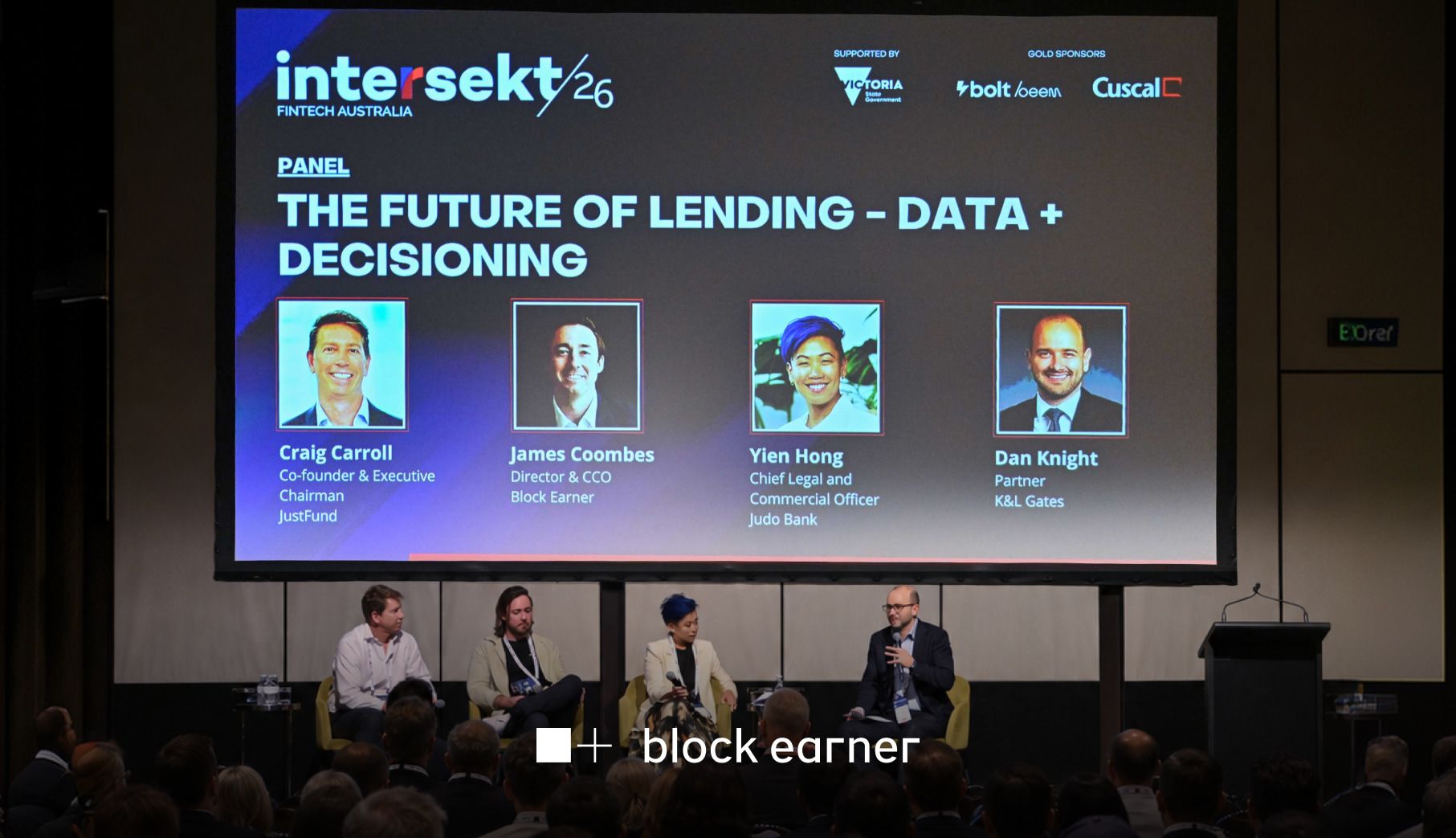
- Won the 2026 FinTech Australia Award for Excellence in Consumer Lending.
This is a meaningful difference from offshore or unlicensed lenders. An Australian Credit Licence brings responsible lending obligations, hardship provisions, and access to external dispute resolution, protections that simply do not exist when you borrow from a platform outside the Australian regulatory perimeter.
Australian Bitcoin-backed loan vs the alternatives
DeFi lenders
Borrowing using DeFi is a legitimate option, and for people who prioritise non-custodial exposure above all else it may be the right one. However, the risk set is technological rather than institutional. Smart contract exploits are not hypothetical, protocols have lost hundreds of millions to them.
Liquidation is the sharpest difference. DeFi protocols have loan-to-value limits too, often with zero notifications. They do not have a 30-day notice period, or a human you can call. A price wick during a volatile hour can liquidate your position algorithmically before you have looked at your phone. Note: these LVR bands and the 30-day notice period apply to personal Crypto-Backed Loans. Business loans are governed by their own terms, which may allow security to be sold without the same notice, check your loan agreement.
Unlicensed offshore lenders
Several established crypto lenders are based overseas. The structural point is not about any particular platform's competence, it is about what you can do if something goes wrong.
An Australian Credit Licence is not a badge. It carries responsible lending obligations, hardship provisions, an internal dispute resolution process, and mandatory membership of AFCA, the external ombudsman scheme. Those apply whether or not the lender wants them to, and they are enforceable by ASIC.
Borrow from an entity outside that perimeter and none of it follows you. Your contract is governed by foreign law, your dispute goes to a foreign court or arbitrator, and your practical recourse in a dispute with a well-resourced overseas company is limited regardless of how the terms read. The recent history of the sector is worth remembering here: the 2022 credit contraction saw several large offshore crypto lenders enter bankruptcy proceedings, and customers spent years in administration queues to recover a fraction of their assets.
This is also why licensing status is worth checking directly rather than inferred from marketing. A platform can hold registrations in other jurisdictions, or an AUSTRAC registration for exchange services, without holding an Australian Credit Licence for lending.
Risks you should weigh before applying
Price volatility. This is the primary risk. A sharp BTC drawdown raises your LVR and can force a repayment, a top-up, or a partial sale of your security.
It is still debt. Interest accrues daily and compounds monthly. A Line of Credit with no required repayments is convenient, but the balance grows if you leave it untouched for twelve months.
Counterparty risk. You are trusting a third party to custody your BTC. Custody standards, licensing, and audit history are the things to check.
No government guarantee. Capital is not covered by the Australian government deposit guarantee.
Frequently asked bitcoin loan questions
Can I get a Bitcoin loan in Australia without selling my BTC? Yes. A Bitcoin-backed loan lets you borrow AUD using BTC as security. You retain ownership and price exposure, and your Bitcoin is returned when the loan is repaid.
How much could I borrow against my Bitcoin? Up to 50% of your BTC's assessed value, from $50 to $5 million, subject to eligibility, assessment and approval. $100,000 of BTC supports a loan of up to $50,000 AUD at maximum LVR.
What is the interest rate on a Bitcoin-backed loan in Australia? Block Earner's Line of Credit is 9.50% p.a. (11.93% p.a. comparison rate) and the Fixed Term loan is 11.50% p.a. (12.17% p.a. comparison rate). A 2% origination fee applies to both. Rates are indicative and subject to change.
Can I withdraw some of my Bitcoin while the loan is open? Possibly. You may withdraw crypto security provided your loan stays within the maximum LVR after the withdrawal. Any BTC still required as security cannot be withdrawn or traded while the loan is active.
What happens if Bitcoin crashes while I have a loan? Your LVR rises. Above 65% on a BTC loan, a 30-Day Default Notice is issued and you have 30 days to repay part of the loan, sell some security, or top up with additional crypto. If the price recovers and your LVR falls below the threshold within that window, no action is needed.
Can I repay early? Yes. There are no early repayment fees on either product. Voluntary repayments reduce the principal, which reduces the interest you pay overall.
Is Block Earner regulated? Block Earner holds Australian Credit Licence 542689 and is registered with AUSTRAC as a Virtual Asset Service Provider and Independent Remittance Provider (100784590).
Can I borrow more than $5 million against my Bitcoin? Block Earner's in-app Crypto-Backed Loans are capped at $5 million. Larger or more complex requirements are handled case by case, Block Earner may offer a bespoke arrangement. If you are looking for a loan larger than $5 million, please book a call with our rather than applying through the standard flow.
Can I borrow against Bitcoin held by a company, trust or SMSF? Personal Bitcoin-Backed Loans are written to individual borrowers, and businesses via Block Earner crypto-backed business loans for company and trust structures. Block Earner does not currently provide loans for bitcoin held in crypto SMSFs.
Explore Bitcoin-backed loans
Disclaimer: The information contained in this blog is general in nature and is provided for informational purposes only. It does not constitute financial, legal, or tax advice, and should not be relied upon as such. Block Earner does not guarantee the accuracy or completeness of any information presented. You should consider your own personal circumstances and seek professional advice before making any financial or investment decisions. Past performance is not indicative of future results. All investments carry risk. Crypto-backed loans carry real risks. The value of your crypto can fall sharply, rapidly increasing your LVR and reducing any initial buffer. This may require you to add security or repay part of the loan and could result in some or all of your crypto being sold.
*Approved applicants only. Terms, conditions, fees and charges apply. *The rate provided above is indicative and your rate may be different based on a variety of factors, including your credit worthiness. Rates are subject to change. ^The comparison rates are based on a secured loan of $10,000 over a term of 3 years. The comparison rate provided includes a 2% origination fee. WARNING: This comparison rate is true only for the examples given and may not include all fees and charges. Different terms, fees or other loan amounts might result in a different comparison rate. Credit provided by Web3 Loans Pty Ltd ACN 668 516 952 and managed by Web3 Ventures Pty Ltd trading as Block Earner (ACN 655 090 869) under Australian Credit License 542689. *Capital is not covered by the Australian government deposit guarantee.